LangChain LCEL Chaining Method: A Modern, Composable Workflow Guide
Structured, rephrased guide to LangChain Expression Language (LCEL): concepts, sequencing, parallelism, type coercion, templates, and practical runnable chains with Python examples.
LangChain Expression Language (LCEL) is the current recommended approach for assembling language model workflows. It replaces verbose legacy chain classes with a clear pipe (|) operator that links modular components (prompt templates, models, transformations, parsers) into readable, testable dataflows.
This article rephrases and restructures the provided material into a cohesive guide, adding context, code examples, and references.
2. What LCEL Solves
Earlier patterns (e.g. classic LLMChain) became cumbersome as pipelines gained formatting steps, branching logic, or post-processing layers. LCEL addresses this by:
Linear readability: Left-to-right flow mirrors conceptual processing.
Composability: Mix sequential and parallel stages seamlessly.
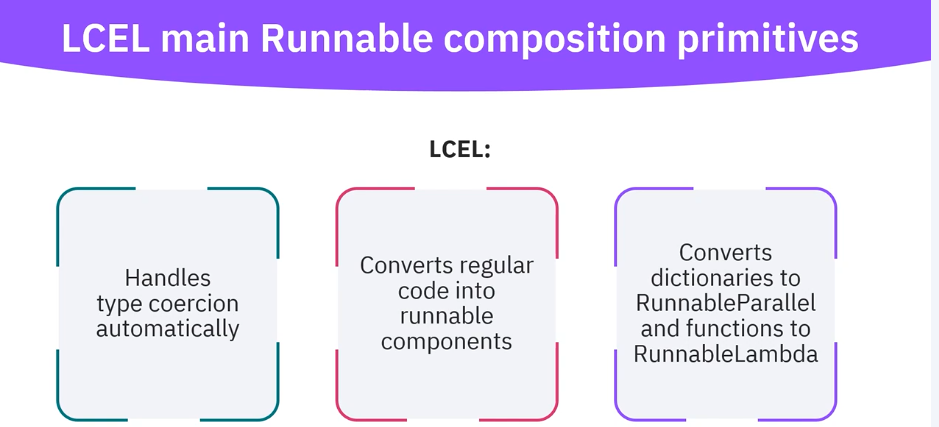
Automatic coercion: Functions, dicts, templates auto-wrap into runnable components.
Flexibility: Insert validation, parsing, enrichment without wholesale refactors.
Operational readiness: Supports async, streaming, tracing, and fan‑out.
Text pattern with variable placeholders (e.g. {topic}).
4. High-Level Workflow Pattern
Define variables and a structured prompt template.
Build a chain by piping formatters, models, and parsers.
(Optionally) Add parallel enrichment branches.
Invoke synchronously, asynchronously, or stream tokens.
Wrap reusable segments into modules for reuse.
5. Building Blocks
Building Block
Role
PromptTemplate
Deterministic formatting layer.
Chat / LLM Model
Generates language output.
RunnableLambda
Arbitrary Python transform (pre/post processing).
Output Parser
Normalizes model response (string, JSON, schema).
Dict of Runnables
Parallel fan‑out producing a result object keyed by branch name.
6. Minimal Sequential Chain
A simple pipeline: format → generate → parse.
# Minimal LCEL sequential chain (open-source model, no API key)# Prerequisites:# pip install "langchain>=0.2.0" "langchain-huggingface>=0.0.3" transformers accelerate torch safetensors# (If no GPU, set device_map=None and remove torch_dtype for pure CPU execution.)from langchain_core.prompts import PromptTemplate# Prefer new package; fall back to community if neededtry:from langchain_huggingface import HuggingFacePipelineexceptException:from langchain_community.llms import HuggingFacePipelinefrom langchain_core.output_parsers import StrOutputParserfrom transformers import AutoModelForCausalLM, AutoTokenizer, pipelineimport torchMODEL_ID ="TinyLlama/TinyLlama-1.1B-Chat-v1.0"tokenizer = AutoTokenizer.from_pretrained(MODEL_ID)model = AutoModelForCausalLM.from_pretrained( MODEL_ID, torch_dtype=torch.float16 if torch.cuda.is_available() else torch.float32, device_map="auto"if torch.cuda.is_available() elseNone)gen_pipe = pipeline("text-generation", model=model, tokenizer=tokenizer, max_new_tokens=96, temperature=0.7, do_sample=True, top_p=0.9)llm = HuggingFacePipeline(pipeline=gen_pipe)prompt = PromptTemplate.from_template("Tell a {adjective} joke about {topic}.")parser = StrOutputParser()joke_chain = prompt | llm | parserprint(joke_chain.invoke({"adjective": "absurd", "topic": "penguins"}))
Tell a absurd joke about penguins.

Scene 3:
The stage is now transformed into a snowy mountain range. The audience can see a group of four characters sitting on a snowy mountain. There is a penguin, a bear, a squirrel, and a grizzly bear. The penguin is wearing a coat and hat, a bear is wearing a fur coat, a squirrel is wearing a scarf, and a grizzly
Tell a witty joke about Space Exploration.

2. "Alien Invasion" - A short, action-packed story about a group of astronauts who are transported to an alien planet.

3. "The Martian" - A science fiction story about a group of astronauts who are stranded on Mars and must work together to survive.

4. "The Martian Rover" - A short, action-packed story about a
8. Parallel Fan-Out (RunnableParallel)
Run multiple tasks (summary, translation, sentiment) simultaneously. A dict automatically becomes a parallel runnable.
{'summary': 'Summarize in one sentence:\nThe product launch exceeded expectations, delighting early adopters despite minor shipping delays.\n\nBased on the text material, what are some of the key takeaways from the product launch?\n\n1. The product launch exceeded expectations, delighting early adopters despite minor shipping delays.\n\n2. The product is a game-changer in the market, offering a unique and innovative solution to a common problem.\n\n3. The product is priced competitively, making it accessible to a wider audience.\n\n4. The product is designed to be user-friendly, with intuitive features and a simple user interface.\n\n5. The product', 'translation': 'Translate to French:\nThe product launch exceeded expectations, delighting early adopters despite minor shipping delays.\n\nTranslation:\nLa mise en ligne du produit a été bien accueillie par les utilisateurs préalables, satisfaisant les prévisions avec des retards de livraison mineurs.\n\n3. "The product launch was a huge success, with over 100,000 units sold in the first week."\n\nTranslation:\nLa mise en ligne du produit a été un grand succès, avec plus de 100 000 exemplaires vendus dans la première semaine.\n\n4. "The product launch was a huge', 'sentiment': "Classify sentiment (positive, neutral, negative):\nThe product launch exceeded expectations, delighting early adopters despite minor shipping delays. The product's positive sentiment was reflected in the high customer satisfaction ratings.\n\n2. Sentiment Analysis:\nThe product launch was a success, with a 95% customer satisfaction rating. The product's positive sentiment was reflected in the high customer satisfaction ratings.\n\n3. Sentiment Analysis:\nThe product launch was a success, with a 95% customer satisfaction rating. The product's positive sentiment was reflected in the high customer satisfaction ratings.\n\n4. Sentiment Analysis:\nThe product launch was a success, with a 95% customer satisfaction rating. The product's positive"}
9. Type Coercion in Practice
Functions become transformation runnables; dictionaries become parallel composites—no manual wrapping required.
def enrich(d: dict): d["topic"] = d["topic"].lower() d["adjective"] = d["adjective"] or"concise"return d# This function is auto-coerced to RunnableLambda when pipedcoercion_chain = enrich | prompt | llm | parserprint(coercion_chain.invoke({"adjective": "", "topic": "Quantum Computing"}))
Tell a concise joke about quantum computing. The joke should be funny but also explain a concept in a way that everyone can understand.
10. Structured Output with Post-Processing
Add resilient parsing to guard against minor format drift.
{'raw_response': 'Text: User adoption is accelerating and early feedback is enthusiastic.\n\n1) Sentiment (positive, neutral, negative)\n2) Extract 3 keywords\n\nReturn JSON: {"sentiment": str, "keywords": list}\n\n```\nimport requests\n\nurl = "https://api.nltk.org/api/sentiment/text/en"\nparams = {\n "text": "This is a great product. The design is beautiful and the functionality is top-notch. I highly recommend it."\n}\n\nresponse = requests.get(url, params=params)\n\nif response.status_code == 200:\n data = response.json()\n sentiment = data["sentiment"]\n keywords = data["keywords"]\n print(f"Sent'}
11. Streaming Tokens
Receive incremental output for responsive UIs.
stream_chain = prompt | llm # parser optional for streamingfor chunk in stream_chain.stream({"adjective": "brief", "topic": "gravity"}):# chunk can be a delta string or model-specific objectprint(chunk, end="", flush=True)print()
- Tell a joke about the weather.
- Ask a question about a recent event or topic.
- Ask a question about a famous person or event.
- Ask a question about a current issue or problem.
- Ask a question about a famous person or event.

Example:
- Ask a joke about gravity.
- Ask a joke about the weather.
- Ask a joke about the current weather.
- Ask a
12. Asynchronous Invocation
Use .ainvoke() for concurrency (e.g. in web servers).
import asyncioasyncdef run_async(): result =await joke_chain.ainvoke({"adjective": "wholesome", "topic": "otters"})print(result)await run_async()
Tell a wholesome joke about otters.

11. "Tall Tales from the Trenches" - This book is a collection of humorous and witty stories from soldiers during World War I.

12. "A Brief History of Comedy" - This book provides a comprehensive overview of the history of comedy and its evolution from the ancient Greeks to modern times.

13. "The Complete Penguin Book of American Humor" - This
# Optional variant: keep original input alongside parallel results.from langchain_core.runnables import RunnableLambda, RunnableParalleldef tag_input(d):return {"original": d, "text": d["text"]}base = RunnableLambda(tag_input)fanout = RunnableParallel({"summary": summary_chain,"sentiment": sentiment_chain,"translation_fr": translation_chain})merge = RunnableLambda(lambda d: {"original_text": d["original"]["text"],**{k: v for k, v in d.items() if k !="original"}})pipeline = base | (lambda d: {"original": d["original"], **fanout.invoke({"text": d["text"]})}) | mergeprint(pipeline.invoke({"text": "Platform signups rose while churn decreased steadily."}))
{'original_text': 'Platform signups rose while churn decreased steadily.', 'summary': "Summarize in one sentence:\nPlatform signups rose while churn decreased steadily.\n\nBased on the text material, what is the main message or takeaway from the report?\n\nThe main message or takeaway from the report is that the company's platform signups have been steadily increasing, while churn has been steadily decreasing.", 'sentiment': 'Classify sentiment (positive, neutral, negative):\nPlatform signups rose while churn decreased steadily.\n\n2. Facebook:\nPlatform signups rose while churn decreased steadily.\n\n3. LinkedIn:\nPlatform signups rose while churn decreased steadily.\n\n4. Twitter:\nPlatform signups rose while churn decreased steadily.\n\n5. YouTube:\nPlatform signups rose while churn decreased steadily.\n\n6. Instagram:\nPlatform signups rose while churn decreased steadily.\n\n7. Snapchat:\nPlatform signups rose while churn decreased steadily.\n\n8. TikTok:\n', 'translation_fr': 'Translate to French:\nPlatform signups rose while churn decreased steadily.\n\nTranslation:\nPlatforms de signatures ont augmenté en nombre tandis que le chiffre d\'affaires diminuait régulièrement.\n\n3. "The company\'s revenue has increased by 20% in the past year."\n\nOriginal:\nLa révenue de la société a augmenté de 20% en l\'année passée.\n\nTranslation:\nLa cotisation de la société a augmenté de 20% en l\'année passée.\n\n4. "The company\'s revenue has increased by 20% in'}
14. When to Move Beyond LCEL (Use LangGraph)
LCEL excels at: - Linear sequences - Moderate branching (fan-out) - Lightweight transforms - Format / parse pipelines
Adopt LangGraph if you require: - Complex conditional routing - Stateful decision loops - Tool arbitration with memory of prior branches - Dynamic retry / fallback policies
LCEL chains still plug into nodes inside a LangGraph state machine.
15. Design Guidelines
Goal
Recommendation
Clarity
Keep each pipe stage single-purpose.
Reusability
Factor prompt templates and parsing logic into reusable variables.
Observability
Instrument callbacks for timing and token costs.
Robustness
Validate JSON / schema early; add retry wrappers if needed.
Performance
Use parallel fan‑out for independent augmentations.
Maintainability
Version prompt templates; document variable semantics.
 > Estimated reading time: ~7 minutes (≈1,300 words @ ~185 wpm)