Advanced Prompt Engineering: Techniques, Tools, and Applications
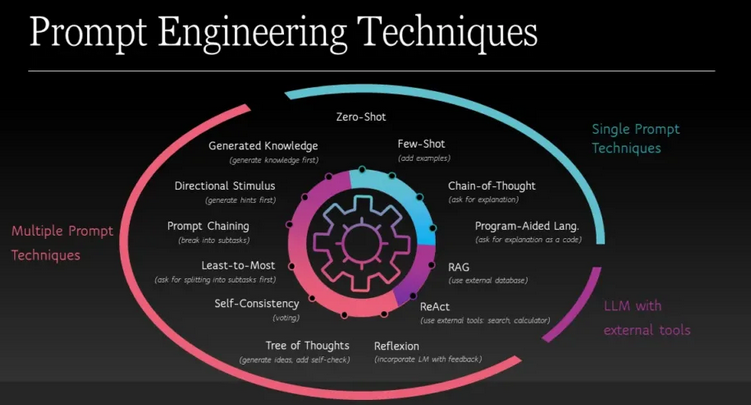
This article summarizes key advanced prompting strategies for large language models (LLMs), explains when to use them, and outlines supporting tooling ecosystems. Techniques covered: zero-shot, one-shot, few-shot, chain-of-thought (CoT), and self-consistency prompting. It also introduces prompt templates and agent-based applications using frameworks such as LangChain.
RAG-AND-AGENTIC-AI
Prompt Engineering
Author
DOSSEH AMECK GUY-MAX DESIRE
Published
August 8, 2025
Estimated reading time: ~6 minutes
Overview
This article summarizes key advanced prompting strategies for large language models (LLMs), explains when to use them, and outlines supporting tooling ecosystems. Techniques covered: zero-shot, one-shot, few-shot, chain-of-thought (CoT), and self-consistency prompting. It also introduces prompt templates and agent-based applications using frameworks such as LangChain.
1. Core Prompting Paradigms
1.1 Zero-Shot Prompting
You supply only an instruction or question. The model relies on its pretraining to infer the task (e.g., fact classification). Best when the task is common or well-aligned with general world knowledge.
1.2 One-Shot Prompting
You provide a single example plus a new input. The example establishes format or output style. Useful when output structure is non-obvious but limited context suffices.
1.3 Few-Shot Prompting
You include a small set (typically 2–10) of labeled examples to demonstrate task patterns (classification, transformation, style). This helps the model generalize formatting, label space, or subtle semantic distinctions without full fine-tuning.
1.4 Chain-of-Thought (CoT) Prompting
You explicitly ask the model to reason step-by-step. This decomposes multi-step arithmetic, logical, or commonsense problems. It increases transparency and often accuracy on reasoning benchmarks by surfacing intermediate inferences.
1.5 Self-Consistency
Instead of taking a single CoT output, you sample multiple independent reasoning traces (with temperature > 0), then aggregate (e.g., majority vote on final answer). This mitigates variance in reasoning paths and often boosts correctness on math and logic tasks.
2. Technique Selection Guide
Scenario
Recommended Technique
Rationale
Simple fact recall
Zero-shot
Minimal overhead
Format imitation
One-shot
Single template suffices
Subtle label mapping
Few-shot
Disambiguates intent
Multi-step reasoning
Chain-of-thought
Structured decomposition
High-stakes reasoning
Self-consistency + CoT
Aggregated robustness
3. Prompt Design Considerations
Clarity: Use unambiguous task verbs (classify, translate, summarize).
Structure: Separate instruction, examples, and query with consistent delimiters.
Brevity: Avoid extraneous prose; reduce noise that can distract token allocation.
Specificity: Constrain style, length, or format (e.g., “Output JSON with keys: label, rationale”).
Incremental Improvement: Iteratively adjust based on observed failure modes (hallucination, formatting drift).
# filepath: /home/ameck/Downloads/langchain_prompt_example.pyfrom langchain_core.prompts import PromptTemplatejoke_template = PromptTemplate.from_template("Tell me a {adjective} joke about {topic}.")prompt = joke_template.format(adjective="witty", topic="penguins")print(prompt)# -> "Tell me a witty joke about penguins."