 > Estimated reading time: ~4 minutes
1. What Is In‑Context Learning?
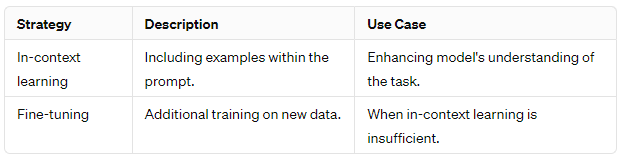
In‑context learning (ICL) is the ability of a large language model (LLM) to infer a new task pattern directly from examples placed inside the prompt at inference time—without updating its weights or performing explicit gradient-based fine‑tuning. You provide a handful of natural‑language demonstrations; the model generalizes the pattern on the fly.
1.1 Key Properties
- No parameter updates: Adaptation happens purely through the prompt.
- Few-shot efficiency: Often just 2–6 curated demonstrations improve quality.
- Rapid iteration: Swap or refine examples to steer behavior instantly.
- Ephemeral adaptation: Behavior reverts once examples are removed (no lasting memory).
1.2 When It Shines vs. When It Struggles
| Quick prototype of a new classification style |
No training pipeline needed |
If volume is huge & latency critical → lightweight fine‑tuned model |
| Highly structured transformation (formatting, extraction) |
Fast prompt tweaking |
If accuracy must exceed strict thresholds |
| Domain with sparse labeled data |
Few curated exemplars suffice |
If task requires reasoning beyond context window |
| Long, complex multi-step reasoning |
May partially follow pattern |
Consider chain-of-thought prompting or tool augmentation |
2. Prompt Engineering: Designing the Interaction Surface
Prompt engineering is the systematic crafting and refinement of instructions + context to reliably elicit desired outputs from an LLM. Think of a prompt as a mini contract between you (intent) and the model (completion behavior).
2.1 Core Objectives
- Increase clarity (unambiguous task specification).
- Provide relevance (only information the model should leverage).
- Enforce structure (schemas, delimiters, output markers) to simplify parsing.
- Control style & tone when needed.
2.2 Four Canonical Prompt Components
| Instruction |
States the task plainly |
Use imperative voice (“Classify”, “Summarize”) |
| Context |
Supplies background / constraints |
Separate with clear labels or fenced blocks |
| Input Data |
The concrete content to act on |
Delimit with markers (e.g. TEXT ...) |
| Output Indicator |
Signals where / how to respond |
Prefix with Answer: or Sentiment: etc. |
2.3 Example (Sentiment Classification)
Instruction: Classify the customer review as Positive, Neutral, or Negative.
Context: Product launched last week; early shipping delays reported.
Review: "The product arrived late but the quality exceeded my expectations."
Output Format: Sentiment=<ONE_WORD>
Sentiment:
2.4 Example (Few‑Shot In‑Context Learning)
You are a sentiment classifier. Use only: Positive | Neutral | Negative.

Review: "Packaging was damaged and instructions missing." → Negative
Review: "Arrived early; setup was quick." → Positive
Review: "Works as described." → Neutral
Review: "Support was slow but ultimately helpful." → Neutral

Now classify:
Review: "The product arrived late but the quality exceeded my expectations." →
3. Advantages of Strong Prompt Design
- Higher accuracy vs. naïve, underspecified prompts.
- Reduced hallucination via explicit scope & constraints.
- Lower need for repeated fine‑tuning on iterative task variants.
- Consistent structure enables downstream automation (parsers, evaluators).
4. Limitations & Mitigations
| Context window saturation |
Excess examples or verbose background |
Compress / summarize; choose prototypical examples |
| Inconsistent style outputs |
Ambiguous or absent formatting guidance |
Provide explicit output template + negative examples |
| Overfitting to exemplar wording |
Too few / non-diverse demonstrations |
Vary phrasing; rotate representative cases |
| Hidden bias in examples |
Skewed demonstration set |
Audit example distribution; add balancing samples |
| Complex reasoning failures |
Requires deeper multi-step logic |
Add chain-of-thought or tool invocation steps |
5. Workflow: Iterative Prompt Refinement Loop
- Baseline Draft: Write minimal instruction + one exemplar. Measure shortcomings.
- Error Log: Categorize failures (format drift, misclassification, ambiguity, hallucination).
- Targeted Adjustments: Add only examples addressing distinct failure modes.
- Schema Locking: Introduce explicit output format / markers once semantics stabilize.
- Regression Set: Maintain a lightweight evaluation batch to prevent regressions.
- Operationalize: Version prompt variants; tie changes to metric deltas.
6. Quick Diagnostic Checklist
7. Frequently Used Enhancements
| Role Priming |
Set behavioral frame |
“You are a meticulous data auditor.” |
| Delimiters |
Prevent spillover |
Use XML-like tags: <input>...</input> |
| Explicit Constraints |
Bound scope |
“Answer with ONLY one of: A,B,C” |
| Error Mode Hints |
Reduce hallucinations |
“If uncertain, answer: Unknown” |
| Self-Check Prompt |
Encourage validation |
“List assumptions before final answer.” |
8. Putting It Together: Composite Prompt Pattern
SYSTEM ROLE: You are an analytical assistant that outputs a single JSON object.
TASK: Extract sentiment and justification.
CONSTRAINTS: Sentiment ∈ {Positive, Neutral, Negative}. If mixed, choose dominant tone.
EXAMPLES:
1) Text: "Loved the speed." -> {"sentiment":"Positive","reason":"praise speed"}
2) Text: "Okay performance." -> {"sentiment":"Neutral","reason":"mediocre"}
3) Text: "Arrived broken." -> {"sentiment":"Negative","reason":"defect"}
INPUT TEXT: <<The product arrived late but the quality exceeded my expectations.>>
OUTPUT ONLY JSON:
9. When to Graduate Beyond Pure Prompting
| Stable high-volume task |
Fine‑tune or distill for cost & latency |
| Need strict reproducibility |
Constrain decoding; use structured parsers |
| Requires external knowledge |
Add retrieval (RAG) layer |
| Complex tool use / workflows |
Introduce orchestration framework (e.g., LangChain / LangGraph) |
10. Key Takeaways
- In‑context learning offers rapid, training‑free adaptation using embedded examples.
- Well‑structured prompts balance instruction clarity, focused context, and explicit output markers.
- Iterative logging + regression evaluation prevents silent degradation.
- Use ICL for agility; move to fine‑tuning or retrieval when scale, precision, or knowledge breadth demand it.
11. References & Further Reading
- Brown et al. 2020. Language Models are Few-Shot Learners. (arXiv)
- Wei et al. 2022. Chain-of-Thought Prompting Elicits Reasoning. (arXiv)
- Prompt Engineering Guide (site)
- LangChain Documentation (site)
- OpenAI Model Guidelines (docs)
- Anthropic Claude Docs (docs)
This primer rephrases and condenses educational material on in‑context learning and prompt engineering for rapid practitioner onboarding.