Estimated reading time: ~5 minutes
1 Introduction
Natural Language Processing (NLP) enables computational systems to interpret, represent, and generate human language. Human speech or writing arrives as unstructured text; NLP methods convert it into structured representations (features, tags, semantic frames, entities) for downstream reasoning.
Conceptual split:
Natural Language Understanding (NLU): unstructured → structured
Natural Language Generation (NLG): structured → natural language
Focus here: NLU.
2 Representative Use Cases
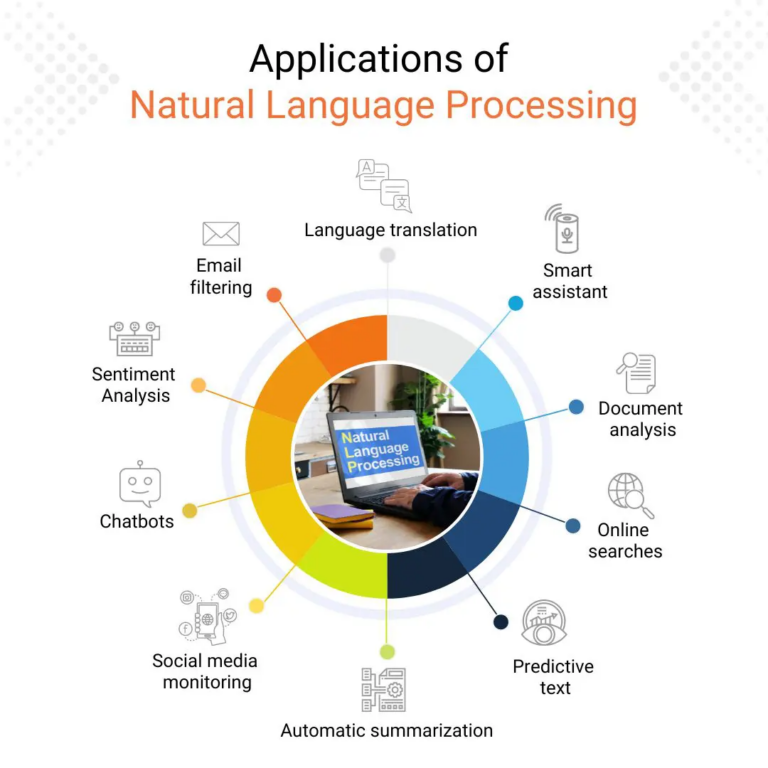
Some applications of NLU are summarized below. Each transforms raw text into structured outputs that enable further processing or decision-making.
| Use Case | Goal | Illustrative Outputs |
|---|---|---|
| Machine Translation | Cross-language meaning preservation | Translated sentence |
| Virtual Assistants / Chatbots | Intent + slot extraction | Intent label, slot values |
| Sentiment Analysis | Polarity / emotion classification | Positive / negative / neutral |
| Spam Detection | Filter unsolicited / malicious content | Spam / ham |
| Information Extraction | Entities, relations, events | (Entity, type), (Relation, args) |
| Content Moderation | Policy / safety screening | Violation flags |
3 From Unstructured to Structured: Pipeline Overview
Modern end‑to‑end transformers internalize many steps, yet the classical pipeline aids transparency, control, and low‑resource adaptation.
3.1 Ingestion and Normalization
Lowercasing (task dependent), Unicode normalization, punctuation and whitespace standardization, optional spelling correction.
3.2 Tokenization
Split text into tokens (words, subwords, characters). Subword (BPE, WordPiece) balances vocabulary size and unknown word handling.
3.3 Stemming vs. Lemmatization
| Aspect | Stemming | Lemmatization |
|---|---|---|
| Method | Heuristic affix stripping | Morphological + lexical analysis |
| Example (“better”) | bet | good |
| Precision | Lower | Higher |
| Speed | Higher | Lower |
Choice depends on semantic sensitivity.
3.4 Part-of-Speech (POS) Tagging
Assign syntactic categories (NN, VB, JJ) using sentence context; supports parsing, disambiguation, feature construction.
3.5 Named Entity Recognition (NER)
Detect and classify spans (e.g., PERSON, ORG, GPE) to enable structured indexing and knowledge graph population.
3.6 Additional Possible Steps
Dependency parsing, constituency parsing, coreference, semantic role labeling, entity linking, intent/slot extraction.
3.7 Output Structuring Example
Raw text: “add eggs and milk to my shopping list”
{
  "intent": "ADD_TO_LIST",
  "items": [
    {"name": "eggs", "qty": 1},
    {"name": "milk", "qty": 1}
  ],
  "target_list": "shopping"
}
4 Machine Translation Nuance
Literal word mapping fails for idioms, morphology, syntax divergence. Neural MT (sequence-to-sequence with attention, later transformers) models contextual dependencies, improving fluency and adequacy over phrase-based statistical systems.
5 Ambiguity and Context
Lexical items (e.g., “make”) shift syntactic role with context. Contextual encoders (transformers) outperform earlier HMM/CRF taggers by modeling long-range dependencies and polysemy resolution.
6 Illustrative Error Anecdote
Round-trip translation distortions of idioms show need for semantic modeling beyond word-level substitution; motivates context-aware architectures and richer evaluation (e.g., COMET, BLEURT) beyond surface n‑gram overlap.
7 Modern Neural Integration
Large pretrained language models implicitly perform tokenization (subword), contextual representation, and multi-task adaptation (POS, NER, sentiment). Explicit intermediate artifacts remain useful for interpretability, rule hybrids, compliance logging, and constrained generation.
8 Evaluation Considerations
| Task | Metrics | Notes |
|---|---|---|
| MT | BLEU, chrF, COMET | Combine automatic + human adequacy |
| Sentiment | Accuracy, F1 | Handle class imbalance |
| NER | Precision / Recall / F1 (span) | Exact span boundaries matter |
| Spam | Precision, Recall, ROC-AUC | Threshold tunes cost trade-off |
| POS | Token Accuracy | Downstream impact varies |
Robust evaluation includes adversarial, domain-shift, fairness, and temporal drift slices.
9 Practical Implementation Notes
- Subword units curb OOV but may fragment semantics; aggregate when needed.
- Lemmatization requires language-specific morphological resources.
- Domain adaptation: continued pretraining or fine-tuning on in-domain corpus.
- Governance: version prompts/models, log preprocessing config and decoding parameters.
10 Ethical and Robustness Considerations
| Area | Risk | Mitigations |
|---|---|---|
| Bias | Demographic stereotypes | Diverse corpora, bias audits, debiasing filters |
| Safety | Toxic / harmful outputs | Content filters, refusal policies |
| Privacy | PII leakage in logs | Redaction, minimization, access control |
| Drift | Language & topic shift | Scheduled re-evals, active learning |
| Hallucination | Fabricated facts | Retrieval grounding, citation enforcement |
11 Summary
NLP transforms raw language into structured, machine-actionable representations via layered processing (tokenization, morphological normalization, syntactic/semantic tagging). Pretrained transformers unify many steps but explicit pipelines remain critical for transparency, control, specialized optimization, and risk management.
12 References
[1] Jurafsky & Martin. 2023. Speech and Language Processing (3rd ed. draft).
[2] Porter. 1980. An Algorithm for Suffix Stripping. Program.
[3] Miller. 1995. WordNet: A Lexical Database for English. CACM.
[4] Brill. 1995. Transformation-Based Error-Driven Learning and POS Tagging. ACL.
[5] Tjong Kim Sang & De Meulder. 2003. CoNLL-2003 Shared Task (NER).
[6] Pang & Lee. 2008. Opinion Mining and Sentiment Analysis. Found. Trends IR.
[7] Sahami et al. 1998. A Bayesian Approach to Filtering Junk E-Mail. AAAI Workshop.
[8] Sutskever, Vinyals, Le. 2014. Sequence to Sequence Learning with Neural Networks. NeurIPS.
[9] Bahdanau, Cho, Bengio. 2015. Neural Machine Translation by Jointly Learning to Align and Translate. ICLR.
[10] Vaswani et al. 2017. Attention Is All You Need. NeurIPS.
[11] Devlin et al. 2019. BERT: Pre-training of Deep Bidirectional Transformers. NAACL.
[12] Brown et al. 2020. Language Models are Few-Shot Learners. NeurIPS.
[13] Wolf et al. 2020. Transformers: State-of-the-Art NLP. EMNLP.
[14] Bird, Klein, Loper. 2009. Natural Language Processing with Python. O’Reilly.
[15] Raffel et al. 2020. Exploring the Limits of Transfer Learning with a Unified Text-to-Text Transformer (T5). JMLR.