> Estimated reading time: ~4 minutes
1 Introduction
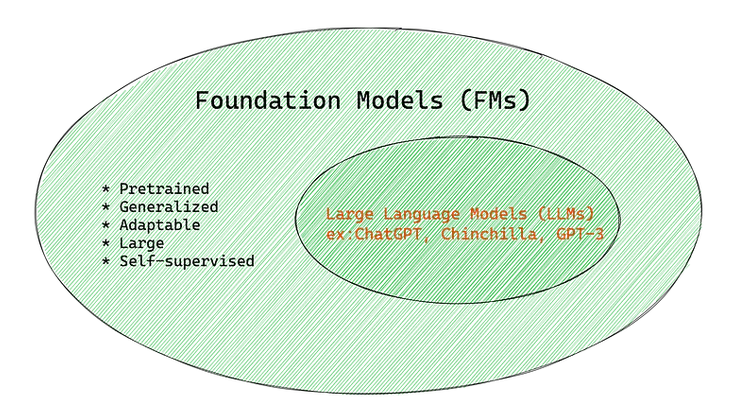
Large language models (LLMs) have accelerated the practical impact of generative AI across tasks such as drafting, summarization, classification, code assistance, and knowledge transformation. These systems are instances of a broader shift toward foundation models—large pretrained models adaptable to many downstream applications with minimal additional data.
2 What Are Foundation Models?
A foundation model is a model pretrained (typically self-supervised) on broad, heterogeneous corpora and then adapted via fine-tuning, lightweight parameter-efficient methods, or prompting to specialized tasks 1. This shifts AI strategy from maintaining many narrow models to cultivating a single adaptable backbone.
3 Pretraining Objective
In language, common objectives include next-token prediction (autoregressive) and masked-token reconstruction. Scaling studies show performance improves predictably with model size, data size, and compute budget 2. Although the base objective is generative, emergent representations enable strong performance on classification, extraction, reasoning, and retrieval-augmented tasks.
4 Adaptation Techniques
| Technique | Data Need | Update Scope | Typical Use Case |
|---|---|---|---|
| Full Fine-Tuning | Medium–High | All parameters | High-stakes domain shifts |
| Parameter-Efficient Tuning (Adapters, LoRA, Prefix) | Low–Medium | <5% parameters | Multi-task / multi-tenant deployments |
| In-Context Prompting (Zero/Few-Shot) | Minimal | None | Rapid prototyping & evaluation |
| Instruction Tuning / Alignment (e.g., RLHF) | Curated instructions & preferences | Select phases | Safer, more helpful behavior |
Representative methods include Adapters 3, LoRA 4, and Prompt/Prefix Tuning 5. Prompt engineering and chain-of-thought styles can further boost reasoning performance 6.
5 Cross-Domain Expansion
Foundation model paradigms now span: - Text-to-Image & Vision (diffusion + text encoders) 7, 13 - Code generation and completion 8 - Molecular and materials discovery (chemical encoders) 9 - Geospatial and climate modeling (earth observation encoders) 10 - Multimodal unification (language + vision + structured data)
6 Enterprise Advantages
- Performance: Strong zero/few-shot baselines reduce labeled data demands.
- Productivity: Reuse one backbone for many workflows.
- Consistency & Governance: Centralized model governance vs. fragmented task silos.
- Extensibility: Rapid addition of new tasks via adapters or prompts.
- Time-to-Value: Prototype with prompting before committing to fine-tuning.
7 Key Challenges
| Category | Challenge | Impact |
|---|---|---|
| Compute & Cost | Training + inference expense | Higher operational TCO |
| Latency | Large parameter counts | UX degradation under concurrency |
| Trust & Safety | Bias, toxicity, hallucination, provenance gaps 1 | Compliance & reputation risk |
| IP & Licensing | Unclear training data composition | Legal exposure |
| Security | Prompt injection, data leakage | Data governance failures |
| Sustainability | Energy & carbon footprint | ESG constraints |
| Evaluation | Benchmark obsolescence | Blind spots in deployment quality |
8 Mitigation Strategies
- Data Curation: Deduplication, toxicity filtering, source stratification.
- Alignment Layers: Instruction tuning, preference optimization, refusal policies, output classifiers.
- Parameter-Efficient Fine-Tuning: Adapters/LoRA to localize risk.
- Inference Optimization: Quantization, sparsity, Mixture-of-Experts, distillation.
- Observability: Structured logging (prompt, output, latency, safety flags).
- Retrieval Augmented Generation (RAG): Ground answers in auditable corpora to reduce hallucination.
- Model & System Cards: Document scope, limitations, risk taxonomy.
- Access & Guardrails: Tiered API policies, prompt sanitization, secret detection.
9 Adoption Playbook
| Phase | Goal | Selected Actions |
|---|---|---|
| Discovery | Identify high-ROI, low-risk targets | Task triage, feasibility scoring |
| Prototype | Validate utility & cost envelope | Prompt variants, small eval set |
| Pilot | Measure KPIs & safety | A/B test vs. baseline models |
| Hardening | Reliability & governance | Monitoring, rollback, guardrails |
| Optimization | Cost & performance tuning | Quantize, batch, adapter library |
| Continuous Assurance | Ongoing trust & drift control | Bias audits, red-teaming, retraining cadence |
Potential KPIs: task accuracy, hallucination rate, latency (P95), cost per 1K tokens, override rate, safety incident count.
10 Hallucination Measurement & Reduction
Measurement: retrieval grounding scores, contradiction detection, uncertainty heuristics (entropy, self-consistency variance), human sampling.
Reduction: retrieval augmentation, constrained decoding, citation enforcement, abstention policies, tool-integrated reasoning.
11 Efficiency & Cost Engineering
- Batching & request multiplexing
- KV-cache reuse for conversational contexts
- Quantization (INT8 / INT4 / QLoRA) 15
- Early exit / layer dropping for latency-sensitive use
- Distillation to smaller specialist models after task stabilization
12 Governance & Compliance
Adopt layered controls: pre-deployment red teaming, model cards, privacy-preserving preprocessing (PII redaction), continuous monitoring dashboards, and periodic fairness & robustness audits aligned with emerging AI regulatory frameworks.
13 Strategic Outlook
Evolving directions: - Modular, composable adapter ecosystems - Energy-aware sparse and low-rank training recipes - Retrieval-grounded verifiable generation - Multimodal and agentic orchestration with auditable tool use - Domain-specialized foundation derivatives for regulated industries
14 Summary
Foundation models provide a unifying substrate for diverse AI capabilities, unlocking performance and productivity while introducing new governance and efficiency challenges. Sustainable value requires disciplined evaluation, alignment, efficiency engineering, and continuous trust assurance.
15 References
[1] Bommasani et al. 2021. On the Opportunities and Risks of Foundation Models. arXiv:2108.07258.
[2] Kaplan et al. 2020. Scaling Laws for Neural Language Models. arXiv:2001.08361.
[3] Houlsby et al. 2019. Parameter-Efficient Transfer Learning for NLP (Adapters). ACL.
[4] Hu et al. 2022. LoRA: Low-Rank Adaptation of Large Language Models. arXiv:2106.09685.
[5] Lester, Al-Rfou, Constant. 2021. The Power of Scale for Parameter-Efficient Prompt Tuning. EMNLP.
[6] Liu et al. 2023. Pre-train, Prompt, and Predict: A Systematic Survey of Prompting. ACM CSUR.
[7] Ramesh et al. 2022. Hierarchical Text-Conditional Image Generation with CLIP Latents (DALL·E 2). arXiv:2204.06125.
[8] Chen et al. 2021. Evaluating Large Language Models Trained on Code (Codex). arXiv:2107.03374.
[9] Ross, J., et al. (2023). Large-Scale Chemical Language Representations Capture Molecular Structure and Properties. arXiv preprint arXiv:2301.09653. [10] Ji et al. 2025. Foundation Models for Geospatial Reasoning: Assessing the Capabilities of Large Language Models in Understanding Geometries and Topological Spatial Relations. arXiv:2505.17136. [11] Brown et al. 2020. Language Models are Few-Shot Learners (GPT-3). NeurIPS.
[12] Ouyang et al. 2022. Training Language Models to Follow Instructions with Human Feedback. arXiv:2203.02155.
[13] Rombach et al. 2022. High-Resolution Image Synthesis with Latent Diffusion Models. CVPR.
[14] Wei et al. 2022. Chain-of-Thought Prompting Elicits Reasoning in Large Language Models. arXiv:2201.11903.
[15] Dettmers et al. 2023. QLoRA: Efficient Finetuning of Quantized LLMs. arXiv:2305.14314.